
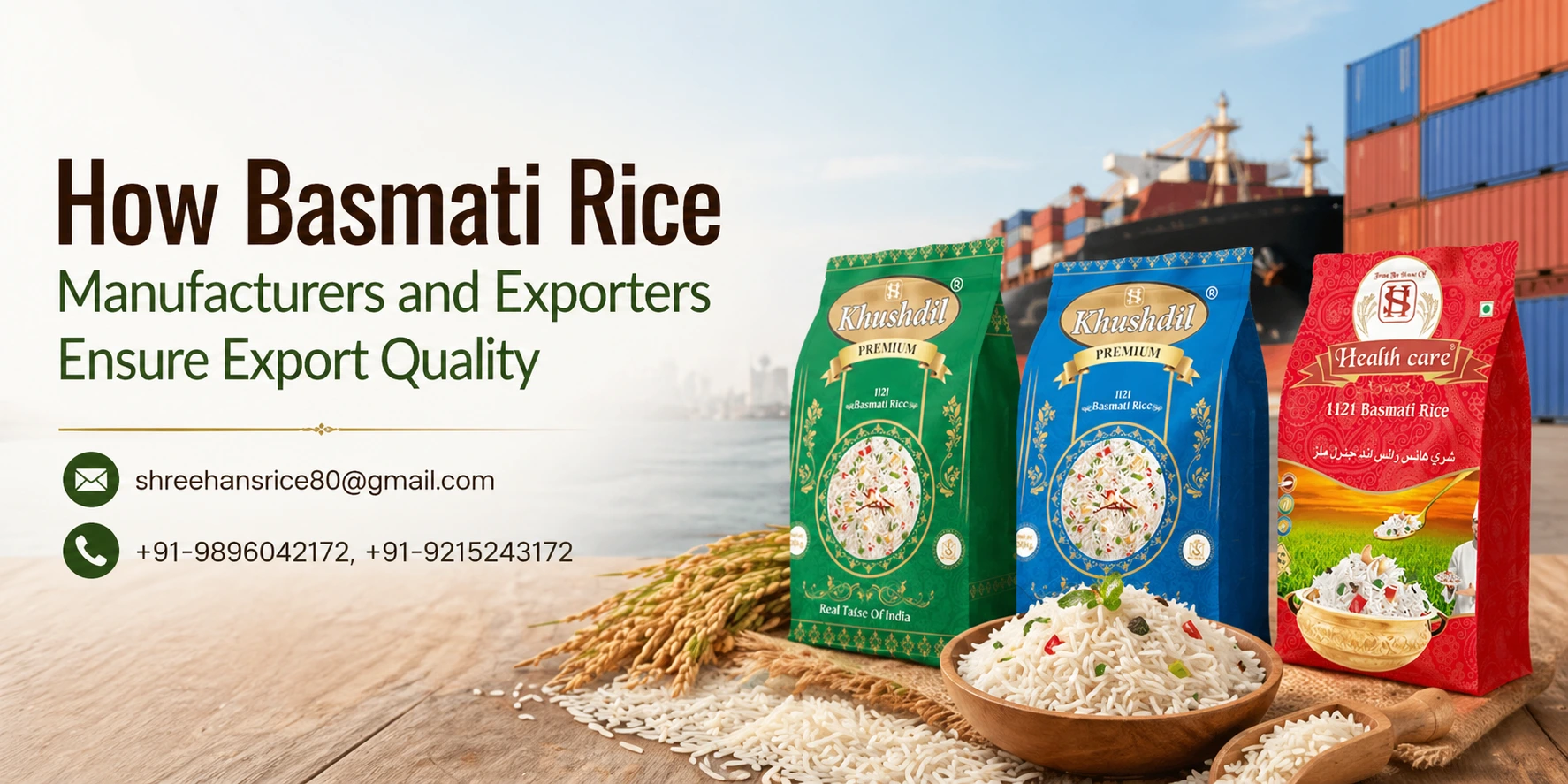
Have you ever tasted an exotic basmati dish that was cooked in a way that filled your kitchen with a unique aroma? If yes, then it probably means that you have used quality rice in cooking. However, there is much work involved in maintaining such quality standards during exportation.
India is the leader in global basmati trade as it exports over 4-4.5 million metric tons annually. At the same time, the country supplies almost 70-75% of the total world exports of this kind of rice.
As far as the overall market size is concerned, it exceeds $10+ billion per year. Major exporters include Saudi Arabia, Iran, the UAE, Iraq, and the USA. Therefore, maintaining consistency in quality is essential.
However, Basmati Rice Manufacturers and Exporters are able to provide consumers with reliable and high-quality goods despite the distance between farms, exporters, and buyers.
Let’s consider the processes involved in maintaining quality throughout the entire chain.
Sourcing Premium Quality Paddy
One might say that rice quality begins where the cultivation of crops starts. That is why only the best basmati rice manufacturers opt for, as seen with top Indian rice millers and exporters:
- 1121 basmati (extra-long variety, great popularity among exporters)
- 1509 basmati (it takes shorter to grow, greater yield, but still premium quality)
- Traditional basmati (high-quality aroma, limited demand on the market).
But even those who have selected the variety need to take additional steps.
They cooperate with trusted farmers to obtain high-quality products. Thus, they benefit from:
- Better traceability and control over grain quality
- Use of proven growing techniques (good agricultural practices)
- Appropriate irrigation, soil management, and limited chemical usage.
Those factors influence the final quality of the grains significantly.
Modern Milling & Processing
Once the crop is harvested and stored properly, it needs to be sent to the mill, where the processing will begin.
Leading rice manufacturers usually use state-of-the-art milling equipment developed by such companies as Bühler and Satake. Typically, such equipment can:
- Clean paddy (remove dust, stones, and other contaminants)
- Dehusk grains
- Polish grains (in some cases).
At the same time, the priority for exporters is maintaining grain length.
Any variation in length reduces the export price and lowers quality, which is why milling requires modern equipment that is capable of performing tasks precisely.
Quality Testing & Control
Maintaining quality is possible with the help of strict controls at every stage of production. Every batch that arrives at the mill needs to be tested according to strict criteria, including:
- Moisture (below 12-13%).
- Proportion of grains that meet the desired length.
- Absence of foreign elements (contaminants).
- Percentage of broken grains.
In most cases, exporters perform in-house tests in special laboratories. Only those batches that pass them go further to processing.
Thus, one can say that quality is achieved without any difficulties.
Aged Storage Conditions
Another factor affecting quality is the ageing process. Only aged basmati is considered premium-quality. Why?
- Firstly, it has a unique fragrance that is hard to find in younger grain.
- Secondly, aged rice is more durable and can cook better (become longer and fluffier).
- Finally, natural ageing reduces moisture levels.
As far as the ageing process is concerned, it takes place in specially equipped warehouses with controlled temperature and humidity levels.
Packing Standards
Once the process of preparing rice comes to an end, packing should start.
Most exporters use: Waterproof packing solutions (PP bags, BOPP bags, vacuum packaging). Private labels for different customers. Moreover, exporters make sure that storage conditions are:
- Hygienic
- Controlled (to prevent pests from entering).
- Ventilated.
Thus, every grain stays untouched and uncontaminated until it leaves the warehouse.
Obtaining Necessary Certifications
The last step in maintaining quality is obtaining certificates and registrations proving the quality of goods. Typical examples of documents obtained by reputable exporters include:
- ISO standards (quality control management system)
- HACCP standards (food safety control).
- APEDA (mandatory for all exporters in India).
These documents serve as guarantees for potential customers of their safety.
Export and Logistics Management
Even high-quality rice is unlikely to stay in good condition without careful transportation. That is why exporters pay special attention to the following aspects of the procedure:
- Careful loading into containers
- Controlled moisture levels
- Fast and accurate shipping.
Shipping conditions may affect rice quality in unexpected ways.
Quality Parameters That Need Checking
Let’s consider a summary of the main parameters that need to be checked while preparing the rice for export.
Parameter | What It Ensures |
Grain Length | Long, uniform grains (premium quality) |
Aroma | Strong, natural basmati fragrance |
Moisture Level | Ideal storage and cooking performance |
Broken Grains | Minimal breakage for better value |
Certifications | Compliance with global standards |
Why Choosing the Right Basmati Rice Manufacturers and Exporters Matters
The quality of basmati rice you get mostly depends on who you buy it from. That’s why choosing the right manufacturer or exporter is important.
When you work with a good supplier, you can expect:
- Regular and reliable supply
- Good and consistent quality
- Prices that don’t change too often
At Shree Hans Basmati, we focus on maintaining consistent quality and providing reliable service to our customers.
If you’re looking for a trusted basmati rice supplier, feel free to connect with us to learn more about our products.
Conclusion
Starting from sourcing paddy and finishing with the delivery to customers, the whole exporting process consists of stages aimed at maintaining quality. Therefore, cooperation with reputable Basmati Rice Manufacturers and Exporters is crucial.
Frequently Asked Questions
Quality is maintained by means of regular checks, tests, and inspections performed at every step of the way.
Ageing enhances aroma, increases rice longevity, and makes it longer when cooked.
Typical documents include ISO standards, HACCP certification, and APEDA registration.
Look for experienced manufacturers with good quality reputation.